Jeff Struecker spent 18 hours in the streets of Mogadishu, Somalia, outnumbered by at least 100 to one. Half his force was killed or wounded. He drove through enemy fire again and again, ferrying the dead and dying back to base. And through every second of it, he had what he describes as supernatural peace.
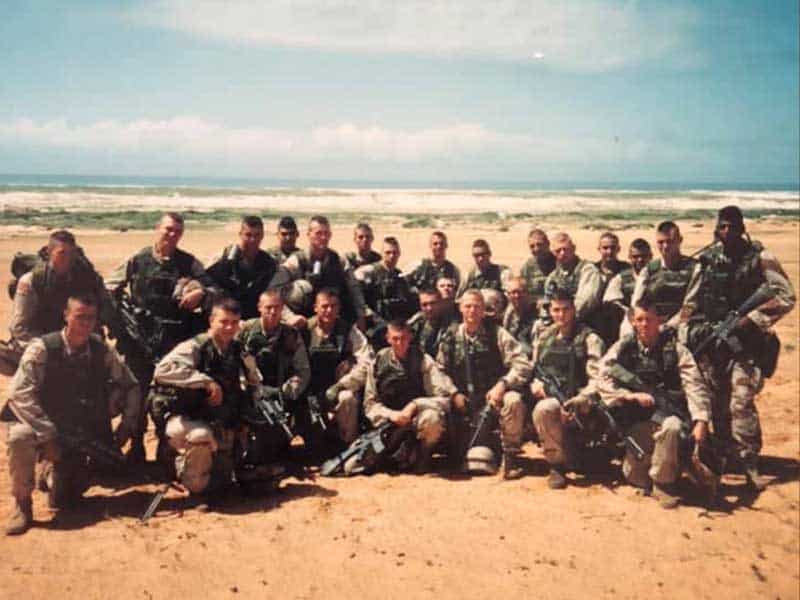
The question of whether a Christian can serve in the military never stayed theoretical for Struecker. He lived the answer under fire, then spent the rest of his career ministering to those who would face the same crucible.
Yes, a Christian can serve in the military. Scripture includes faithful warriors throughout both Testaments, from Abraham leading 300 men into battle to the Roman centurion Jesus praised for great faith (Matthew 8:5-13). Military service is never condemned in the Bible. And Jeff Struecker, an Army Ranger who fought in one of the most brutal modern battles in American history and then became a military chaplain, is living proof that faith and military service are not only compatible. Faith may be the one thing that makes the weight of service bearable.
On episode 261 of the March or Die podcast, Jeremy Stalnecker sat down with Struecker to talk about faith under fire, the question that has followed both men for decades, and what it means to keep marching when the easier option is to quit.
From Black Hawk Down to the Chaplaincy: Jeff Struecker’s Testimony
Struecker’s faith story starts long before Mogadishu. At 13 years old, a young married couple living across the hall from his apartment sat down and explained the gospel to him. He grew up in a home where no one prayed, no one went to church, and no one talked about God. He describes himself as “the kid farthest from Jesus on planet Earth.”
That night changed everything. And there has not been a single day since where he questioned whether what happened was real.
The problem was what came next. His family moved constantly, two or three times per school year. He never saw that couple again. He doesn’t even remember their last name. But every time he moved, he got up and walked to the closest church, sat in the back row without the right clothes or money for the offering plate, and kept showing up.
Real discipleship didn’t come until years later, when he was a sergeant in the Army with a vehicle and enough freedom to connect with a pastor who took his faith seriously. Struecker was already a Ranger by then, already had multiple combat deployments behind him. His faith was deep. His understanding of what it looked like to walk it out day by day was still catching up.
“I feel like there’s some years of my life that I could have been a lot more effective if somebody would have helped me figure out what it looks like to be a disciple,” Struecker explains. “A disciple making disciples.”
By the time he reached Mogadishu in 1993, he had already seen combat in Panama and Desert Storm. But nothing prepared him for 18 hours of sustained urban warfare against overwhelming odds, with no close air support, no armor, no artillery, and no extraction plan.
After the battle, Rangers were waiting for him at the airfield. They started asking about Jesus.
“Jeff, I watched you in the city streets and we have the same training and we have the same experiences, but you obviously have something that I don’t have,” they told him. Others said they had heard his voice on the command net. Everyone in the chain of command was losing control. His voice was calm. They needed to know why.
“That was, hands down, my call to ministry,” Struecker says.
Jeff Struecker’s testimony is not a tidy conversion story. It was forged across decades of combat, loss, and obedience.
He went straight to his pastor and his unit chaplain and asked them the same question: How do you know if you’re being called into ministry? Both told him to get an education. So he stayed in the Ranger Regiment as an enlisted soldier, finished an undergraduate degree, left the military to complete seminary, and came back on active duty as a chaplain before September 11th.
The transition was harder than he ever expected.
The Hardest Battle: Learning to Fight a Different Way
Struecker tells a story from his chaplain basic course that captures the shift. The class went to a live-fire range at night. Machine guns opened up overhead. While other chaplain candidates curled into the fetal position, Struecker took off running straight toward the enemy fire. Years of Ranger training had made the response automatic.
Then it hit him. He didn’t have a weapon.
“I had a Bible in my cargo pocket. I don’t have a rifle in my hands. How am I supposed to bring value to the battlefield?” Struecker recalls. “I had to unlearn a lot of what I learned.”
His first assignment was a field artillery battalion in the 82nd Airborne Division. He had never served outside special operations. He didn’t know the first thing about howitzers. On his first trip to the field, he showed up in full camouflage while the artillerymen ate Doritos in the open, pointing out that camouflage face paint doesn’t help much when you’re firing a gun that can be heard from a mile away.
The lesson went deeper than tactics. Struecker had to learn that his focus was no longer the enemy. His focus was now the souls of American warriors on the battlefield. For the rest of his career, he had to keep reminding himself of that truth.
“I would have been a really bad chaplain had I not learned that lesson early on,” he admits. “And maybe by making a mistake or two early on.”
When September 11th came, he deployed to Afghanistan with that same artillery unit. And for the first time, he saw the full breadth of the military he had spent his entire career serving alongside but never truly known.
What the Bible Actually Says About Soldiers
The question comes up every time Struecker speaks. He estimates he has been asked more than 3,000 times: How can you be a Christian and go to war and kill people? The related question, is it a sin to kill in war, demands the same careful look at what Scripture actually teaches.
His answer, and the bible verses for soldiers he points to, draws on the full arc of Scripture.
Abraham led roughly 300 men into a nighttime battle against five kings to rescue his nephew Lot (Genesis 14:14-16). Moses marched the armies of Israel to war against entire nations at God’s command. David, whom the Bible calls “a man after God’s own heart” (1 Samuel 13:14, Acts 13:22), was arguably the greatest warrior who ever lived. No one in recorded history took more lives in battle.
“Are you telling me that Abraham, Moses, and David are not Christians?” Struecker asks. “Because it sounds like that’s what you’re saying to me.”
The New Testament carries the pattern forward. When soldiers came to John the Baptist asking what they should do, he didn’t tell them to leave the military. He told them to be honest and content with their wages (Luke 3:14). Jesus healed the centurion’s servant and declared that he had not found such great faith in all of Israel (Matthew 8:5-13). The apostle Paul compared the Christian life to soldiering and told Timothy to “endure hardship as a good soldier of Christ Jesus” (2 Timothy 2:3-4). And Cornelius, a Roman centurion, became the first Gentile convert in the book of Acts (Acts 10).
Scripture never condemns military service. What it condemns is injustice, cruelty, and faithlessness, regardless of profession.
Faith Under Fire: What Combat Reveals About Belief
Both Struecker and Jeremy Stalnecker push back hard on the idea that faith and military service exist in tension. For both men, faith was not something they carried into combat like extra gear. It was the foundation that held everything else together.
Jeremy describes leading Marines into Baghdad during the invasion of Iraq in 2003. Without his faith, he says, “there’s no way I would have been able to even contextualize what happened and move on with my life.” He goes further: “I don’t know how you can do it if you’re not a Christian.”
Struecker agrees. During the Battle of Mogadishu, when he was certain he would die, he felt no fear. Not because he was reckless or numb. Because the question of eternity had been settled for him at 13 years old.
“I believe in a sovereign God. He’s gonna decide what happens next,” Struecker explains. “I’m gonna go out there, I’m gonna pull the trigger, I’m gonna do my job to the best of my ability, and some people are gonna live, some people are gonna die. I’m probably gonna be one of them, but I have nothing to worry about. It’s in God’s hands.”
That peace was visible. It was audible over the radio. And it became the most powerful testimony of his life, because Rangers who had dismissed his faith for months were suddenly standing in front of him saying, “Right now, I need you to tell me about Jesus, Sergeant.”
A family friend and Marine officer once told Jeremy something that has stayed with him for decades: “The military is a dark place, but if you take all of the light out, you have nothing left.” Struecker puts it even more directly: “Bring on the darkness. The darker it is, the more my light has a chance to shine.”
The question has never been whether a Christian can serve in the military. The better question is what happens to the military when the people most equipped to carry its moral weight refuse to stay in the fight.
When the Fight Calls You Forward
Every person faces moments where the bullets are flying, whether literal or figurative. Financial collapse. Broken relationships. The weight of trauma that refuses to lift. A diagnosis. A deployment that never seems to end.
Struecker has been on road marches where every step felt impossible. He has counseled soldiers who wanted to quit breathing, let alone marching. His answer to those moments is plain:
“When the real crisis moments happen, you have two choices. I can freeze and stay where I’m at and let life dictate the results. Or I can get up and I can face what’s happening to me.”
Struecker doesn’t promise the outcome will be good. He doesn’t offer cheap comfort. He says honestly that it might all blow up anyway. But he also says this: at the end of his life, he wants to look back and know he held nothing back.
And when he stands before Jesus, he wants to hear one thing.
“Well done, good and faithful servant. You wanted to freeze, you wanted to die, but you didn’t. You got up and marched anyway. Now enter into the rest that I prepared for you.”
That is the call. Not to earn God’s approval, but to honor it. To march as hard and as far as possible, anchored in the truth that the one who holds eternity also holds every step between here and there.
FAQ
Can a Christian serve in the military?
Yes. The Bible contains numerous examples of faithful warriors, including Abraham, David, and the Roman centurion whom Jesus praised for great faith. Scripture never condemns military service. Jeff Struecker, a Black Hawk Down Army Ranger who became a military chaplain, demonstrates that faith and combat service are fully compatible.
Is it a sin to kill in war?
The Bible distinguishes between murder (unlawful killing motivated by hatred or personal gain) and killing in the context of warfare or defense of others. Old Testament warriors like David fought at God’s command and were called men of faith. The key is not whether a soldier fights, but whether they fight with integrity and under lawful authority.
What does the Bible say about soldiers?
Scripture speaks positively of soldiers multiple times. John the Baptist told soldiers to serve honestly (Luke 3:14). Jesus praised a centurion’s faith (Matthew 8:5-13). Paul compared Christian discipleship to soldiering (2 Timothy 2:3-4). And Cornelius, a Roman centurion, was the first Gentile to receive the Holy Spirit (Acts 10).
How do soldiers deal with moral injury?
Moral injury occurs when someone participates in or witnesses events that violate their moral framework. For Christian service members, anchoring identity in Christ and engaging with pastoral counsel or veteran-focused ministry programs can provide a foundation for processing the moral weight of combat. Organizations like Mighty Oaks Foundation and chaplains like Jeff Struecker specifically serve warriors navigating these challenges.
Who is Jeff Struecker?
Jeff Struecker is a retired U.S. Army chaplain and former Army Ranger who served in the Battle of Mogadishu (depicted in the book and film Black Hawk Down). He enlisted while still in high school, served in Panama, Desert Storm, and Somalia as a special operations soldier, then earned his education and returned to active duty as a military chaplain. He completed 14 combat deployments and now serves as a senior pastor.
Watch the full conversation with Jeff Struecker: Episode 261 of March or Die.
Subscribe to The Forward Edge for weekly perspective on faith, purpose, and forward movement.
Ready to get in the fight? Learn about Men of Action.
Learn more about Jeff Struecker’s ministry and his free series “A Warrior’s Soul” at jeffstruecker.com.